

Voice AI ROI: The Real Numbers Behind Automating Your Phone Line
Search Voice AI ROI and you will find case studies talking about millions of dollars in annual savings, hundred thousand call volumes, and enterprise contact centres with entire floors of staff. None of that tells you anything useful about what automating your own phone line will actually return. At Bolder Digital, when we walk a client through the real numbers, we build the calculation around their actual business, not a call centre they will never resemble.
Let me walk you through the genuine formula, the mistake almost everyone makes when applying it, and a conservative, small business worked example.
The Formula, and the Mistake Almost Everyone Makes With It
Return on investment is genuinely simple as a formula. Benefits gained minus cost, divided by cost. The mistake sits almost entirely on the cost side. Most people anchor purely on a receptionist's wage and stop there, which consistently undercounts the true comparison by a significant margin. The honest comparison needs the fully loaded cost, wages, superannuation, leave entitlements, and genuine overhead, which is exactly why I have written elsewhere in this series that a full time receptionist in Australia genuinely costs somewhere between sixty five and ninety thousand dollars a year once everything real is included, not the base salary figure alone.
Three Value Streams Worth Counting, Not Just One
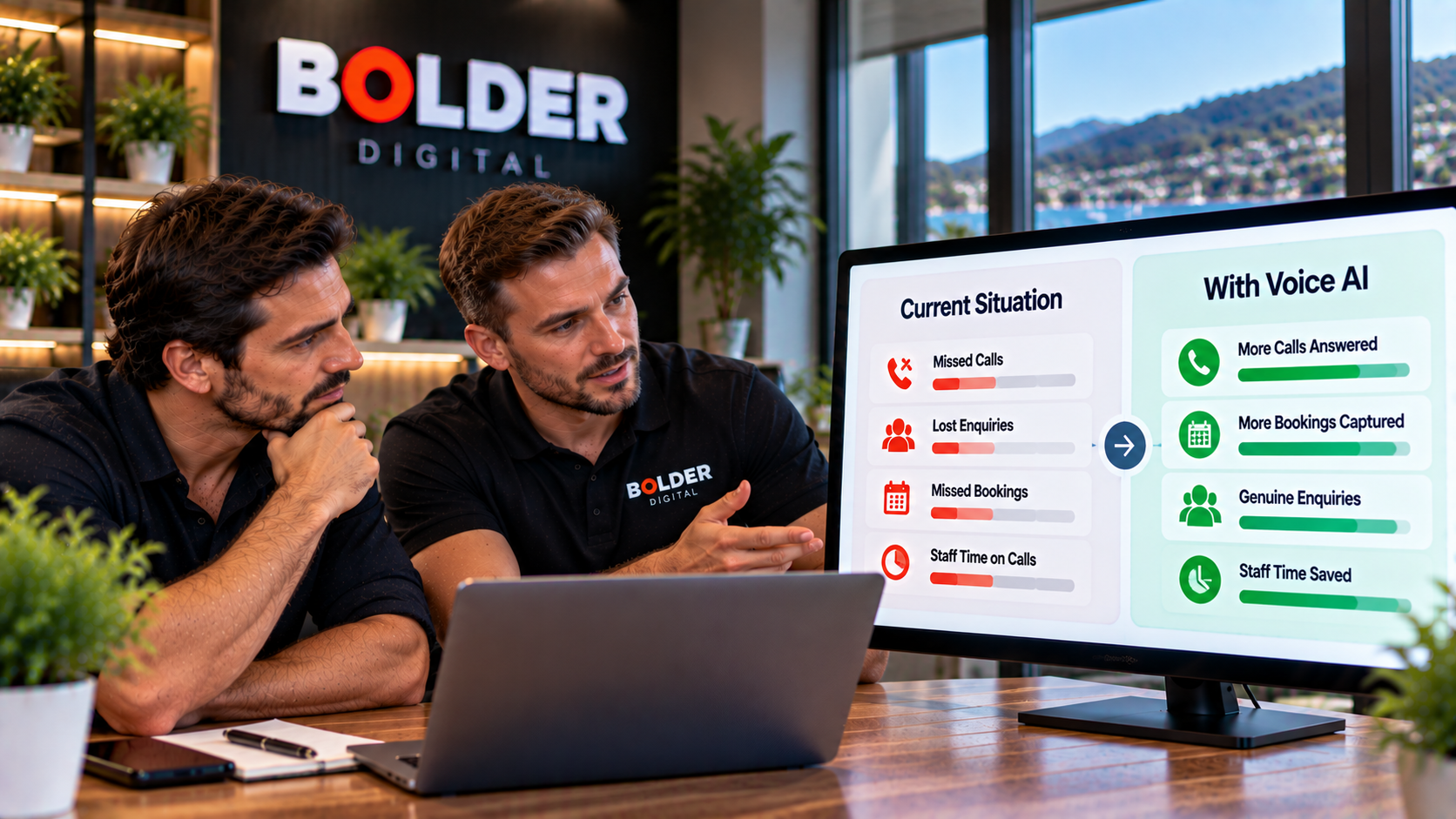
A genuine ROI calculation for voice AI should account for more than a single number. Three distinct streams are worth counting separately.
Coverage you would otherwise pay for.What it would genuinely cost to have someone answering the phone during the hours you actually need covered.
After hours capture.The value of calls arriving outside those hours entirely, which a human receptionist structurally cannot cover regardless of how good they are.
Recovered missed calls.Calls that would otherwise go unanswered during business hours itself, when every line is already occupied.
Treating these as one vague benefit tends to either understate or wildly overstate the real number. Treating them separately makes the calculation something you can actually defend.
A Conservative, Small Business Worked Example
Let me build this properly rather than borrow an enterprise figure that means nothing for a business your size. Take a trade business paying roughly twenty nine hundred dollars a month for a properly built, custom voice agent, thirty five thousand a year, a realistic figure at the upper end of what I outlined in the pricing piece I wrote earlier in this series.
Commonly cited industry figures suggest twenty to thirty percent of inbound business calls go unanswered or abandoned during business hours alone, before after hours is even considered. Conservatively assume this business recovers just one genuinely new job a week from calls that would previously have gone unanswered, at an average job value of three hundred dollars. That is roughly fifteen thousand dollars in additional annual revenue from recovered calls alone.
Separately, assume after hours calls, arriving across the roughly one hundred and twenty eight hours a week a human receptionist never covers, produce just one additional booking a fortnight, again at three hundred dollars. That is another seventy eight hundred dollars annually.
Add these two streams together, twenty two thousand eight hundred dollars in recovered and after hours revenue, against a thirty five thousand dollar annual cost, and you land at a first year return of roughly sixty five percent. Not the eighteen times return you will see quoted in some of the more dramatic content online, but a genuinely defensible, conservative number built from assumptions you can actually stand behind in front of your own accountant.
Why Being Conservative About the Automation Rate Matters
I deliberately used a single job a week and a single fortnightly after hours booking in that example, not the full missed call percentage applied optimistically across every single one. Assuming every missed call converts, or that the agent handles every single scenario perfectly from day one, is exactly the kind of assumption that collapses the first time someone actually checks your numbers. A conservative starting assumption, refined upward once real data comes in after a few months of genuine use, protects the credibility of the whole business case.
What This Actually Adds Up To
Once you add tool consolidation savings, if this business is currently paying for a separate answering service or booking tool it can now retire, the return climbs further again, and this is exactly where the genuine ROI case for voice AI tends to live for a small business, a real, defensible return well above the cost of the platform, built from multiple honest, modest assumptions rather than one dramatic claim.
How Bolder Digital Approaches This
Before we ever recommend a voice agent, we work through this exact calculation with the client directly, their actual call volume, their actual average job value, and a genuinely conservative estimate of what gets recovered in the first few months. We would rather hand you a defensible sixty five percent than an inflated number that falls apart the first time someone checks it.
You can see how this fits into ourAI Receptionist service, built around a genuine, verifiable return for your specific business, not a case study borrowed from a call centre a hundred times your size.
The Bottom Line
Genuine voice AI ROI for a small business rarely looks like the enterprise case studies you will find online, and it does not need to in order to be a genuinely strong result. Built from the true, fully loaded cost of the alternative, and counted across coverage, after hours capture, and recovered calls separately, a conservative, honest calculation regularly lands well above the cost of the platform itself, without needing to borrow a number that was never built for a business your size in the first place.

Frequently Asked Questions
What is the most common mistake businesses make calculating voice AI ROI?
Anchoring purely on a receptionist's base wage rather than the fully loaded cost, including superannuation, leave, and genuine overhead. This consistently understates the true comparison and makes the eventual return look smaller than it actually is.
Should I count every missed call as a lost sale when calculating ROI?
No, this overstates the case. A conservative estimate, counting only a modest, realistic share of recovered calls, produces a defensible number you can stand behind, rather than an inflated figure that assumes every single missed call would have converted.
Why should coverage, after hours capture, and recovered calls be calculated separately?
Treating them as one vague benefit tends to either understate or overstate the real return. Calculating each stream on its own, using conservative assumptions for each, produces a number that is considerably easier to defend and explain.
What kind of first year return is realistic for a small business using voice AI?
A conservative, honestly built calculation regularly lands somewhere in the range of a first year return well above the platform's cost, often in the range of fifty to one hundred percent depending on call volume and average job value, without needing to rely on the dramatic, enterprise scale figures often quoted online.
Jarryd Holmes, Founder & Owner, Bolder Digital | Prospect Vale, Tasmania |bolderdigital.com.au