
You can see how this fits into our local SEO services in Norwood, our review management service, and our Google Business Profile optimisation.
Look at the Google profiles of businesses in a quiet suburb like Norwood, and a familiar pattern appears. A handful of reviews, mostly from a few years back. Few replies. No sign of anything recent. It is not that the customers are unhappy. It is that nobody has built a way of asking, so reviews arrive by accident. At Bolder Digital, we think that is the biggest gap in local SEO for suburban businesses, and it is also one of the cheapest to fix. If that sounds like you, this is the strategy to put in place.
Norwood in Brief
Norwood is a residential suburb about five kilometres south east of the Launceston city centre, and it includes the small locality of Queechy. It had around 3,900 residents at the 2021 census, with a median age of 47, older than many Launceston suburbs. It borders Kings Meadows, Newstead, Punchbowl, and St Leonards, and it uses postcode 7250. Norwood Primary School and Queechy High School serve local families.
It is a settled community where reputation travels by word of mouth. That makes reviews especially valuable, because they are word of mouth made public.
Why Reviews Matter So Much Here
In a suburb where people know each other, a recommendation from a neighbour carries weight. But most people also check online before they call, and what they find is your Google profile. US survey data suggests nearly all consumers read reviews for local businesses, and most expect at least four stars. Those figures are American, but the habit is not.
Reviews also feed local rankings. They are one of the signals Google weighs when deciding which businesses to show, alongside relevance and distance. A business with fresh, genuine reviews has an edge over one with an identical profile and none.
The Missing Piece Is a System
Businesses that get steady reviews do not rely on luck. They run a simple, repeatable process with four parts.
Ask every customer, at a sensible moment.
Make it easy to leave a review.
Reply to every review.
Use what the reviews tell you.
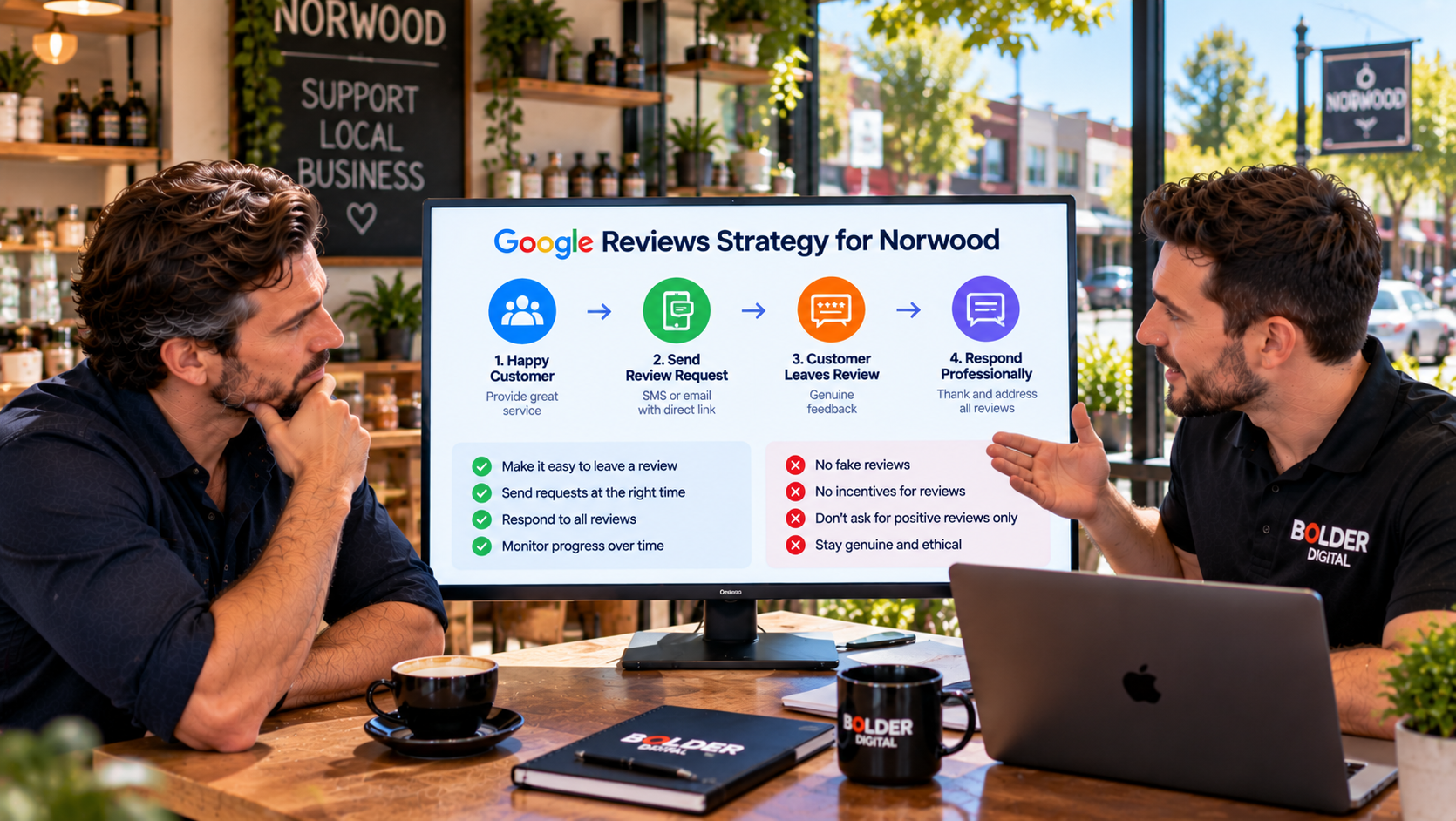
1. Ask Everyone, at the Right Time
The best time to ask is just after something has gone well, when the experience is fresh. That might be when a job is finished, an appointment has ended, or a delivery has arrived. A good rule is to send the request within a day, with one polite reminder if there is no response.
Two principles matter more than any script:
Ask every customer. Google prohibits selectively asking only the people you expect to be happy, or steering unhappy ones to a private form. That practice is called review gating.
Do not pressure anyone. Several 2026 guides report that Google is cracking down on pushing customers to leave reviews while they are still on your premises. A gentle invitation by text or on a receipt is safer than someone hovering with a tablet.
2. Make It Easy
Every extra step costs you reviews. Google provides a direct review link and a QR code for your profile, and both are allowed. Use them:
send the link by text or email after the visit
print the QR code on invoices, receipts, quotes, and a sign
test the link on both an iPhone and an Android phone, so you know it works
For a suburb with an older population, make sure there is more than one route. Not everyone is comfortable with QR codes, and some do not have a Google account. A short phone call explaining the steps, a printed card with simple instructions, or a note that a family member can help all make it easier. Never write the review for someone, and never offer to.
3. Keep the Request Honest and Neutral
The wording of your request matters. A good one is short and friendly, and does not steer:
“Thanks for choosing us. If you have a minute, we’d really appreciate an honest review of your experience.”
Avoid telling people what to say, asking them to name staff, or asking for a particular star rating. Some 2026 guides report that Google now treats asking customers to mention staff names and similar steering as violations. A good review is written in the customer’s own words. If you are unsure, keep the request plain.
4. Never Offer Rewards
This is a hard rule. Google treats offering discounts, gifts, entries, or anything else in exchange for reviews as fake engagement. It applies even if you say the review can be honest. The penalties can include reviews being removed, a warning banner, or the profile being restricted. It is also not worth the risk under Australian consumer law, which generally treats fake or incentivised reviews as misleading.
Reviews from staff, family, and friends who are not genuine customers also break the rules. Keep them out.
5. Reply to Every Review
Replying is half the strategy, and most businesses skip it. In US survey data, far more consumers said they would use a business that replies to all its reviews than one that replies to none. Replies also show potential customers how you treat people.
Good replies are:
Prompt. Aim for within a few days.
Personal. Mention something specific from the review, not a stock line.
Short. Two or three sentences is plenty.
Careful about privacy. Do not reveal anything about the customer’s matter or confirm details you would not share elsewhere.
6. Handle Negative Reviews Calmly
Every business gets one eventually. What matters is how you answer.
Stay calm, and never argue in public.
Thank them, acknowledge the issue, and say what you will do.
Offer to talk offline, with a direct contact.
Fix the problem if you can.
Only ask Google to remove a review if it breaks the rules, such as spam, a conflict of interest, or abuse. Do not ask the reviewer to remove it in exchange for something.
A handful of less than perfect reviews, answered well, makes the good ones more believable.
7. Keep a Steady Rhythm
A burst of twenty reviews in one week followed by silence looks odd, and does less for you than a trickle that continues. Aim for a few new reviews a month, and let it grow. Recent reviews matter, because people want to see you are still doing good work.
When Reviews Go Missing
Sometimes reviews you expect do not appear. Google filters content it considers suspicious, and practitioners report that many reviews arriving from the same device or network can be flagged. Do not panic, and do not try to work around the filters. Keep asking real customers in the normal way, and the flow will follow.
Use What Customers Tell You
Reviews are free feedback. Read them every month and look for themes. If several customers mention friendliness, say so in your marketing. If several mention slow replies, fix that. Share your best reviews on your website and social media, with the reviewer’s permission where you name them, as we cover in our piece on social proof.
Measure It
Track a few simple numbers:
new reviews per month
your average rating, and how it trends
the share of reviews you have replied to, and how quickly
how many new customers mention reviews when you ask how they found you
A Norwood Review Checklist
Put one person in charge of review requests.
Ask every customer, within a day of finishing.
Use Google’s direct link and QR code, and test them.
Offer more than one way for customers who prefer it.
Keep the request honest and neutral.
Never offer rewards, gate, or use staff and family reviews.
Reply to every review within a few days.
Read the reviews monthly, and act on what they say.
How Bolder Digital Approaches Norwood
At Bolder Digital, we set up a review process that suits how your business works. We create the link and QR code, write the request and reply wording, build the follow up into your invoices and messages, and keep everything within Google’s rules. You can see how this fits into our local SEO services in Norwood, our review management service, and our Google Business Profile optimisation.
The Bottom Line
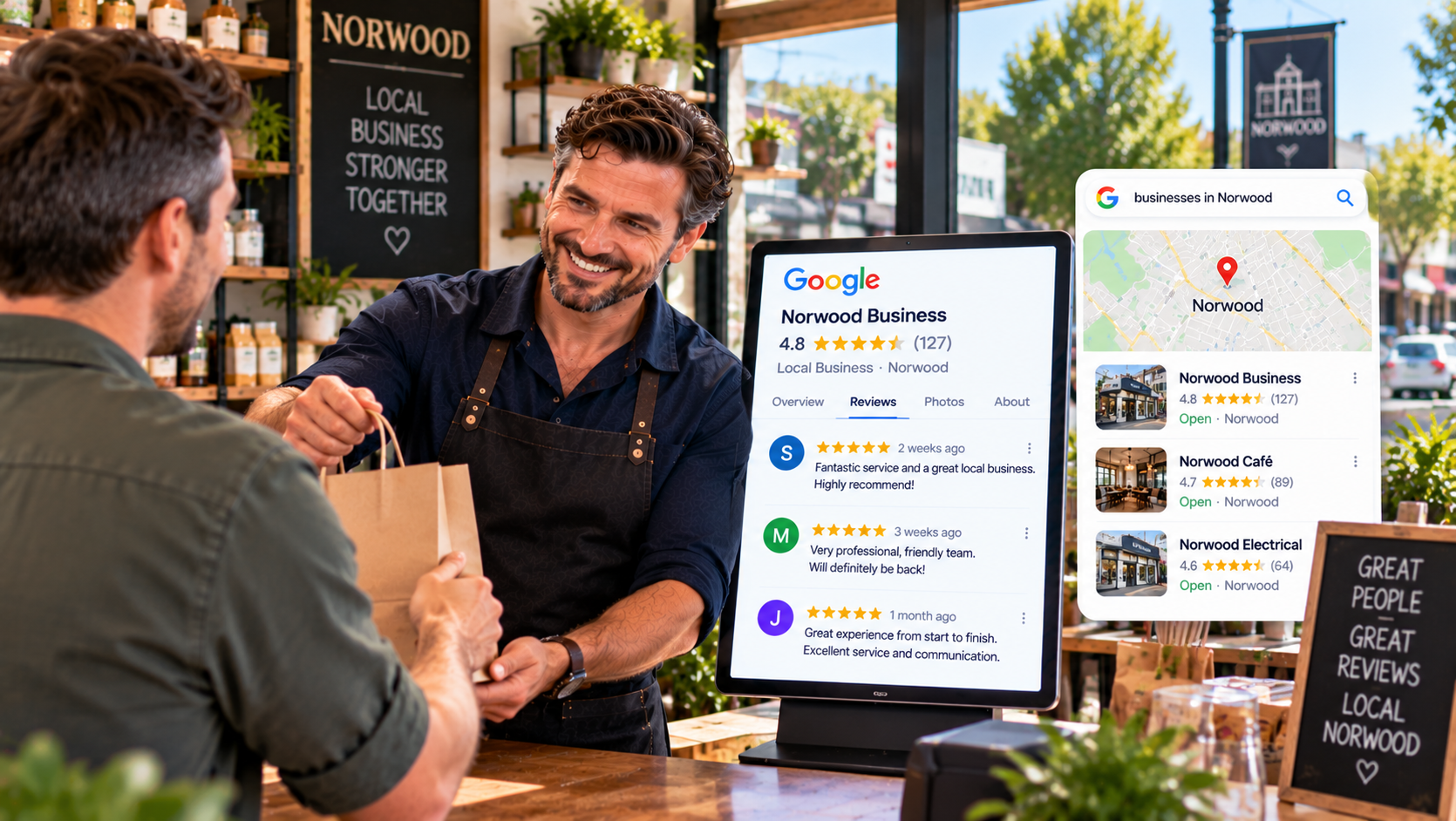
In a close knit suburb, reviews are word of mouth made visible, and most businesses leave them to chance. Build a simple system. Ask everyone at the right moment, make it easy, keep the request honest, reply to everything, and use what you learn. Do it steadily and within the rules, and your profile will start working as hard as your reputation already does.
Frequently Asked Questions
How do I ask customers for Google reviews?
Send every customer a direct review link or QR code soon after the job or visit, with a short, honest request and one polite reminder. Use Google’s own link, and test it on different phones.
Can I offer a discount for a review?
No. Google prohibits incentives for reviews, and treats them as fake engagement, with penalties that can include removed reviews and profile restrictions. Fake or incentivised reviews are also generally treated as misleading under Australian consumer law.
Can I only ask happy customers?
No. Selectively asking customers you expect to be positive, or steering unhappy ones elsewhere, is called review gating and is against Google’s policy. Ask everyone.
How should I reply to a negative review?
Calmly and briefly. Thank them, acknowledge the issue, say what you will do, offer to talk offline, and do not reveal private details. Only report a review to Google if it breaks the rules.
What if my customers are not comfortable with QR codes?
Offer other routes, such as a text or email link, a printed card with simple steps, or a short phone call explaining how. Never write the review for them.
Jarryd Holmes, Founder & Owner, Bolder Digital | Prospect Vale, Tasmania | bolderdigital.com.au