
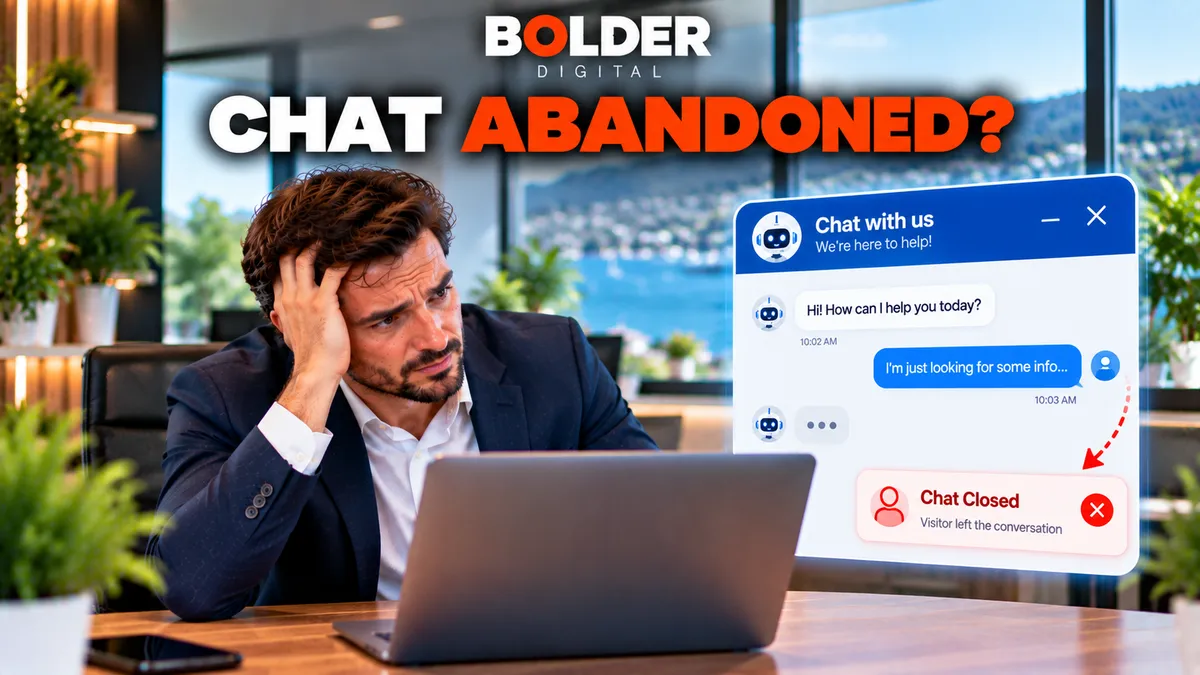
AI Chatbot Abandonment: Why Visitors Close the Window and How to Fix It
A meaningful share of every chatbot's conversations end the same way. Not with a resolved question, not with a booked appointment, just a visitor quietly closing the tab. At Bolder Digital, when we take over an underperforming chatbot, reviewing exactly where these abandoned sessions actually broke down is one of the first things we do, and the same handful of specific, fixable moments show up again and again.
Let me walk you through what they actually are.
The Dead End Loop: When There's No Way Forward
This is one of the most common, least obvious failure patterns. A conversation drifts off the flow the chatbot was built for, the visitor asks something slightly unexpected, and there is no genuine way to recover, no path to escalate, no way to start over, nothing but the same response repeating itself. The chat window is technically still open, but the interaction is already over. Without a real re-entry or escalation path built in, a conversation that goes even slightly off script starts to feel like a trap, and most visitors abandon it the moment that feeling sets in.

The Wait That Feels Too Long
Response speed inside a chat matters more than most businesses expect. A visitor who has asked a question and is now staring at a static screen loses patience considerably faster than the same wait would feel over email. Once a genuine delay sets in, impatience takes over quickly, and the visitor is gone before an answer ever arrives. This is exactly why a properly built chatbot responds close to instantly for anything it can genuinely answer, rather than making a visitor wait through an artificial delay.
Asking for Contact Info Before You've Earned It
I have written about this specific mistake before in the context of qualification, and it deserves its own mention here directly. Asking for an email address or a phone number before offering any genuine value creates exactly the kind of friction that causes a visitor to simply close the window rather than hand over their details to a conversation that has not yet proven it is worth continuing. Value first, contact details second, consistently outperforms the reverse.
The "I Already Told You That" Problem
A chatbot that forgets what a visitor just said, repeating the same generic response or asking for information already provided, erodes trust remarkably fast, even when the individual answers it gives are technically accurate. Visitors notice immediately when the tone never varies and the conversation never actually builds on what came before. This is exactly why proper session memory, tracking what has already been said and adjusting accordingly, matters as much as the accuracy of any single answer.
When Escalation Goes Nowhere
A chatbot correctly recognising it needs to hand a conversation to a person is only half the job. If that handoff leads to genuine silence, nobody actually responding for an extended period, the experience ends up worse than if no escalation had been offered at all. This is exactly the same principle I have written about for voice AI handoffs, and it applies just as directly here. An escalation promise only works if a real person is genuinely there to receive it.
Recovering From Abandonment: What a Genuine Win-Back Message Looks Like
Not every abandoned conversation is actually lost for good. If contact details were captured before a visitor disappeared partway through, a genuine, specific follow up, referencing exactly what they were asking about rather than a generic "still interested?" message, can recover a real share of these conversations. Timing matters here too. A follow up sent within a few hours, while the original interest is still fresh, performs considerably better than one sent days later once the moment has genuinely passed.
How Bolder Digital Approaches This
When we build or take over a chatbot, we deliberately design real recovery paths for the moment a conversation drifts off script, rather than letting it dead end. We test response speed properly before launch, sequence contact requests to come after genuine value has been offered, and build in the session memory that stops a conversation feeling like it is starting fresh with every single message. Where a handoff to a person is promised, we make sure someone is actually there to receive it.
You can see how this fits into ourAI Chatbot service, built around keeping a visitor genuinely engaged through to a resolution, rather than optimising purely for how the chatbot performs when everything goes exactly to plan.
The Bottom Line
Chatbot abandonment rarely comes down to one single cause. It is usually a handful of specific, identifiable moments, a conversation with no way forward, a wait that felt too long, a contact request that arrived too early, a memory lapse that made the whole interaction feel mechanical, or an escalation promise nobody actually kept. Reviewing where your own abandoned sessions actually break down, rather than assuming the chatbot itself is simply not working, is what turns this from an invisible leak into something genuinely fixable.

Frequently Asked Questions
Why does a chatbot conversation sometimes feel like it has no way forward?
This usually happens when the conversation drifts slightly off the flow the chatbot was built for, and there is no genuine escalation or re-entry path built in. Without one, the chat keeps repeating the same limited response, and most visitors abandon it once that dead end becomes obvious.
How quickly does a chatbot need to respond to avoid losing visitors?
Close to instantly for anything it can genuinely answer. Patience inside a chat window drops considerably faster than in other channels like email, and a visible, extended delay is one of the more common reasons a visitor simply closes the tab.
Why does asking for an email or phone number too early hurt chatbot performance?
It creates friction before any genuine value has been offered, and a visitor with no reason yet to trust the conversation is considerably more likely to leave than to hand over their details. Offering something useful first, then asking for contact information, consistently performs better.
Can an abandoned chatbot conversation actually be recovered?
Often, yes, if contact details were captured before the visitor left. A genuine, specific follow up referencing exactly what they were asking about, sent within a few hours while their interest is still fresh, can recover a real share of these conversations.
Jarryd Holmes, Founder & Owner, Bolder Digital | Prospect Vale, Tasmania |bolderdigital.com.au