
AI Chatbot Security: What Actually Happens to the Data Visitors Share
People tell chatbots things. Names, phone numbers, email addresses, a description of a problem, and sometimes details they should not share at all. They type quickly, because it feels like a casual chat. Behind that friendly window, the message is going on a journey, and at Bolder Digital we think every business owner should understand it. Not because chatbots are unsafe, but because the risks sit in places most people do not look.
Follow One Message Through the System
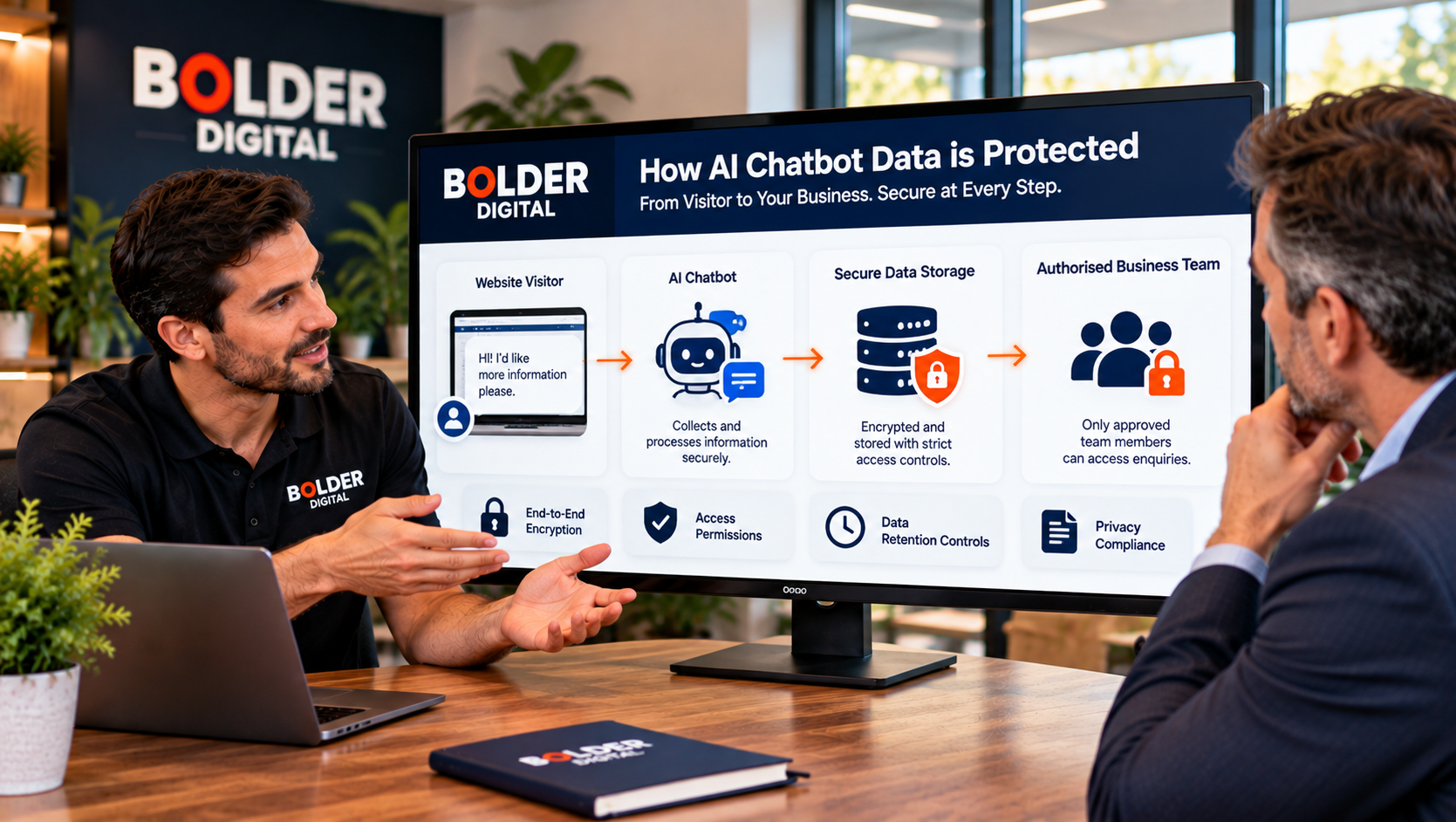
When a visitor sends a message, it usually passes through several places:
Their browser and your website. The chat widget is a piece of code running on your site.
The chatbot platform. The message is sent to the vendor’s servers, which may be in Australia or overseas.
An AI model provider. To write a reply, the platform often sends the conversation to a language model run by another company.
Your own systems. If the visitor leaves details, they may be written into your CRM, sent by email or SMS, or added to a calendar.
Logs and transcripts. Conversations are usually stored, sometimes for a long time.
Each step is a place where data can be kept, seen by someone, or leaked. So the useful question is not “is the chatbot secure?” It is “who can see this message at each step, and for how long?”
What Has Actually Gone Wrong
Two widely reported incidents from 2025 show where the real risks sit, and neither was the AI misbehaving.
A hiring chatbot exposure. Security researchers found that an administrator account on a recruiting chatbot platform used a default password of 123456, and that a backend interface lacked proper access checks. The reported result was exposure of records for tens of millions of job applicants, including chat transcripts. There was no evidence the weakness was exploited maliciously, but the access was possible.
A chatbot integration breach. Attackers stole access tokens that a chat product used to connect to customers’ CRM systems, then used them to pull data from hundreds of organisations. The tokens carried broad permissions, and the activity looked like normal chatbot behaviour.
The lesson is consistent. The failures were weak passwords, poorly protected interfaces, and integrations with more access than they needed. The threat is rarely the AI. It is what the AI is connected to.
Risks That Are Specific to AI Chatbots
A few risks are particular to this technology. The OWASP list of top risks for AI applications highlights several.
Prompt injection. Someone types instructions designed to make the chatbot ignore its rules, such as telling it to reveal its hidden instructions. A related version hides instructions in a document or web page the chatbot reads.
Sensitive information disclosure. The chatbot says something it should not, such as another customer’s details, if it has access to them.
Excessive access. A chatbot that can read or change too much can be tricked into doing harm.
The practical protections are not mysterious. Give the chatbot only the access it needs. An assistant that answers common questions should not be able to query your entire customer database. Require human approval for anything sensitive. Treat the AI as something that can be talked into mistakes, and test it by trying to do exactly that.
Collect Less in the First Place
The safest data is data you never collect. A good chatbot asks for what it needs to help, such as a name and a contact method, and nothing more. It should not invite long accounts of personal circumstances, health details, or identity numbers. It should also never take card numbers in chat. Payments belong on a proper, secure payment page.
A short message at the start helps. It can say the visitor is speaking with an AI assistant, ask them not to share sensitive details, and link to your privacy policy.
What Australian Rules Mean for You
The Privacy Act applies to most businesses with annual turnover above three million dollars, and to some smaller ones, such as health service providers. Many very small businesses fall outside it, but professional confidentiality duties and general good practice still apply, and the law has been moving towards wider coverage.
If the Act applies to you, a few obligations matter for chatbots:
Telling people what you collect and why. The OAIC’s guidance on AI products says notices should cover AI related purposes, and that if the AI provider can access personal information, that is a disclosure to mention.
Overseas disclosure. If chat data goes to a provider overseas, you stay responsible for how it is handled.
Reasonable security. You must take reasonable steps to protect personal information.
Data breach notification. Covered organisations must notify affected people and the OAIC about serious breaches.
Access and deletion. People can ask to see the information you hold about them.
The OAIC also recommends caution about entering personal information, especially sensitive information, into public AI tools. From 10 December 2026, new transparency rules about automated decision making will also apply to many businesses covered by the Act. If you send follow up emails or texts after a chat, the Spam Act requires consent and an unsubscribe option.
Questions to Ask Any Chatbot Provider
Before signing, ask:
Where is our data stored and processed?
Which AI model providers do you send conversations to, and where are they?
Is our data used to train any models? Can we opt out?
How long are transcripts kept, and can we delete them?
Is data encrypted when it moves and when it is stored?
How is access to our data controlled, and is two step sign in required for administrators?
What permissions do your integrations ask for, and can we limit them?
How and how fast will you tell us if there is a breach?
Can we export or delete everything if we leave?
A provider who answers these plainly is a good sign. Evasion is a warning.
Your Own Housekeeping
Much of the risk sits with you, not the vendor.
Use strong, unique passwords and two step sign in on every admin account.
Remove test and demo accounts when you finish with them.
Limit who can see transcripts.
Review connected apps every few months and remove any you no longer use.
Set a retention period and delete old transcripts.
Keep personal customer details out of the chatbot’s knowledge base.
Know what you would do if something went wrong, including who to call and how to revoke access.
How Bolder Digital Approaches This
At Bolder Digital, we treat security as part of the build. We keep the chatbot’s access to your systems as narrow as it can be, design the intake to collect the minimum, add a clear AI and privacy notice, secure the admin accounts, and test the chatbot against attempts to talk it out of its rules before it goes live. You can see how this fits into our AI Chatbot service.
The Bottom Line
What happens to the data visitors share depends on a chain of decisions: what you collect, where it goes, who can see it, how long it is kept, and what the chatbot is allowed to touch. The headline breaches have come from weak passwords and over generous integrations, not from clever AI. Collect less, limit access, ask vendors the hard questions, and look after your own accounts. A chatbot built that way is easier to trust.

Frequently Asked Questions
Where does a chatbot’s data actually go?
Usually from the visitor’s browser to the chatbot platform’s servers, often on to an AI model provider, and then into your own systems such as a CRM or email. Conversations are commonly stored as transcripts, so ask where and for how long.
Can a chatbot be tricked into revealing information?
Yes. Attackers can try prompt injection, which tries to override the chatbot’s instructions. The best defence is limiting what the chatbot can access, so there is little to reveal, and testing it against such attempts.
Is my business covered by the Privacy Act?
Many businesses with turnover above three million dollars are, and some smaller ones are too, such as health service providers. Professional confidentiality duties and good practice apply to everyone. Confirm your position with a lawyer.
Should visitors share sensitive details with a chatbot?
Generally no. A chatbot should collect only what it needs, ask visitors not to share sensitive information, and never take card details in chat.
What is the biggest security risk with chatbots?
Not the AI itself. Reported incidents have involved weak admin passwords, poorly protected interfaces, and integrations with excessive access. Secure accounts and tightly limited permissions matter most.
Jarryd Holmes, Founder & Owner, Bolder Digital | Prospect Vale, Tasmania | bolderdigital.com.au