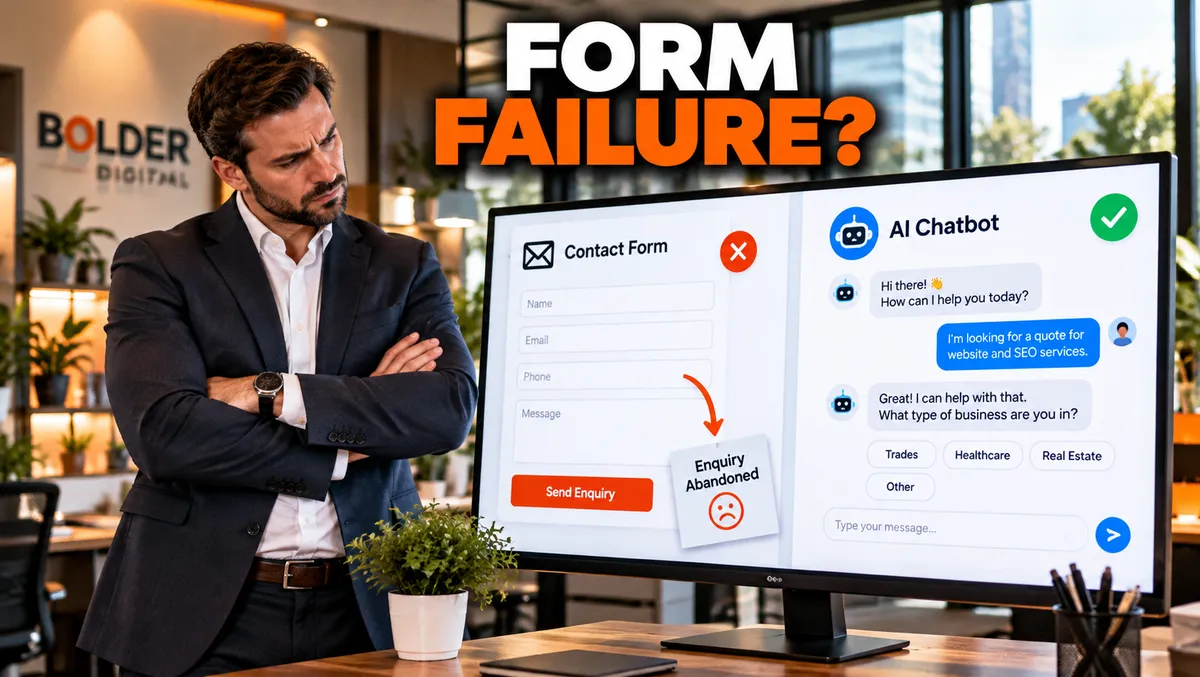
AI Chatbot vs Email Contact Forms: Which Actually Converts
Search this question and you will find confident answers that chatbots beat contact forms three to five times over. At Bolder Digital, we build both, and our honest answer is less dramatic. They do different jobs, and the businesses getting the best results are usually the ones that stop treating it as a contest.
What the Numbers Say, and What They Do Not
Vendor reports commonly put contact form conversion somewhere between two and five percent of visitors, and AI chatbot conversion at ten to twenty percent or more. Some sources claim form abandonment as high as two thirds or more of the people who start filling one in, though estimates vary widely.
Treat those figures with care for two reasons:
They come mainly from companies selling chatbots.That does not make them wrong, but it does make them optimistic.
They are not like for like.A form's rate is usually measured against everyone who sees it. A chatbot's rate is often measured against people who chose to start a conversation, who are already more interested. Comparing the two directly flatters the chatbot.
What the research does support is speed. The Harvard Business Review study of 2,241 US firms found an average response time of about 42 hours, with a large share never replying at all, and that firms replying within an hour were far more likely to qualify a lead. A form that sends an enquiry into an inbox nobody checks until the morning loses to anything that answers sooner.

Where Forms Still Win
A contact form is not obsolete. It works well when:
the enquiry is complex and structured, such as a detailed quote request, an application, or a formal complaint
the person wants to write a full message in their own time and attach files
you need a clear written record
the visitor prefers not to chat, or uses assistive technology that works better with a standard form
the matter is sensitive and you do not want it in a conversation window
Many professional services, for example, are better off with a short, clear form for detailed matters.
Where Chatbots Win
A chatbot does better at the front of the funnel:
First contact:someone with a quick question who would never fill in a form.
After hours:it answers at 9pm, while a form just sits there.
Mobile visitors:typing into fields on a phone is a chore, and a short chat is easier.
Qualification:it can ask a few relevant questions and route the enquiry properly.
Booking:it can offer times and confirm an appointment on the spot.
The common thread is that a chatbot lowers the effort of the first step and gives an immediate answer.
If You Keep a Form, Fix These
Many forms lose enquiries for reasons that are easy to fix:
Too many fields.Studies and vendors consistently find that each extra field lowers completion. Ask for what you need to reply, and nothing more.
Required phone number.If you do not need to ring them, make it optional.
No sign of what happens next.Tell people when to expect a reply.
Slow or no reply.Send an immediate confirmation and reply as quickly as you can.
Poor mobile layout.Test it on a phone.
Spam.Use protection that does not make real people jump through hoops.
If You Add a Chatbot, Fix These
Chatbots have their own failure modes:
Poor training.A chatbot that gives wrong answers does more harm than no chatbot.
Too many questions up front.Answer first, then ask.
No human path.Make it easy to reach a person.
Hiding the phone number.Some people simply want to call.
Accessibility.Check that it works for keyboard and screen reader users.
The Better Answer Is Usually Both
For most small businesses, the strongest setup puts the two together:
A chatbot greets visitors, answers common questions, qualifies the enquiry, and books where it can.
Everything it captures lands in the same place as your form submissions, with the same fields, in your CRM.
A short form remains as a fallback for people who prefer it or have a detailed request.
Your phone number and a click to call button stay visible.
That way, nobody is forced down one route, and you can compare how each performs.
How to Test It Fairly
If you want to know what works for your business, run a simple test for about four weeks:
Measure enquiries per hundred visitors for each route, using the same denominator.
Record how many enquiries were genuine and suitable.
Track how fast each was answered.
Follow them through to booked jobs and paying customers.
The number that matters is customers and cost per customer, not conversions in isolation. A route that produces fewer but better leads can win.
Consent and Privacy Apply Either Way
Whatever you use, collect consent for any follow up by email or SMS at the point of capture, and keep it simple to unsubscribe, in line with the Spam Act. Tell visitors they are speaking with an AI assistant if you use a chatbot, and ask your provider where chat transcripts are stored, since they can contain personal information.
How Bolder Digital Approaches This
At Bolder Digital, we do not push a chatbot where a form would do. We look at what your visitors actually need, then set up the right mix, usually a chatbot for first contact and a short form for detailed enquiries, with both feeding one system so nothing gets lost. You can see how this fits into ourAI Chatbot service.
The Bottom Line
Chatbots and contact forms are tools for different moments. Forms suit detailed, structured, or sensitive enquiries. Chatbots suit quick questions, after hours visits, and mobile users. The claims that one beats the other three times over come mostly from vendors and are not like for like. Test both with your own traffic and measure what matters, which is the customers they produce.

Frequently Asked Questions
Do chatbots really convert better than contact forms?
Vendor reports often say so, with chatbots converting several times higher. But the comparisons are rarely like for like, since chat figures usually count only people who started a conversation. Test both on your own site and measure customers, not just enquiries.
When should I keep a contact form?
For detailed or structured enquiries, formal complaints, sensitive matters, file attachments, or visitors who prefer to write a full message. A short form also works well as a fallback next to a chatbot.
Why do so many people abandon contact forms?
Common causes are too many fields, required phone numbers, unclear next steps, and poor mobile layouts. Shortening the form and telling people what happens next helps.
Can I use both a chatbot and a form?
Yes, and for most small businesses it is the best option. Both should feed into the same CRM so nothing is lost and you can compare their results.
How should I test which one works for my business?
Run both for about four weeks, measure enquiries per hundred visitors for each, note how many were suitable and how quickly they were answered, and follow them through to paying customers.
Jarryd Holmes, Founder & Owner, Bolder Digital | Prospect Vale, Tasmania |bolderdigital.com.au