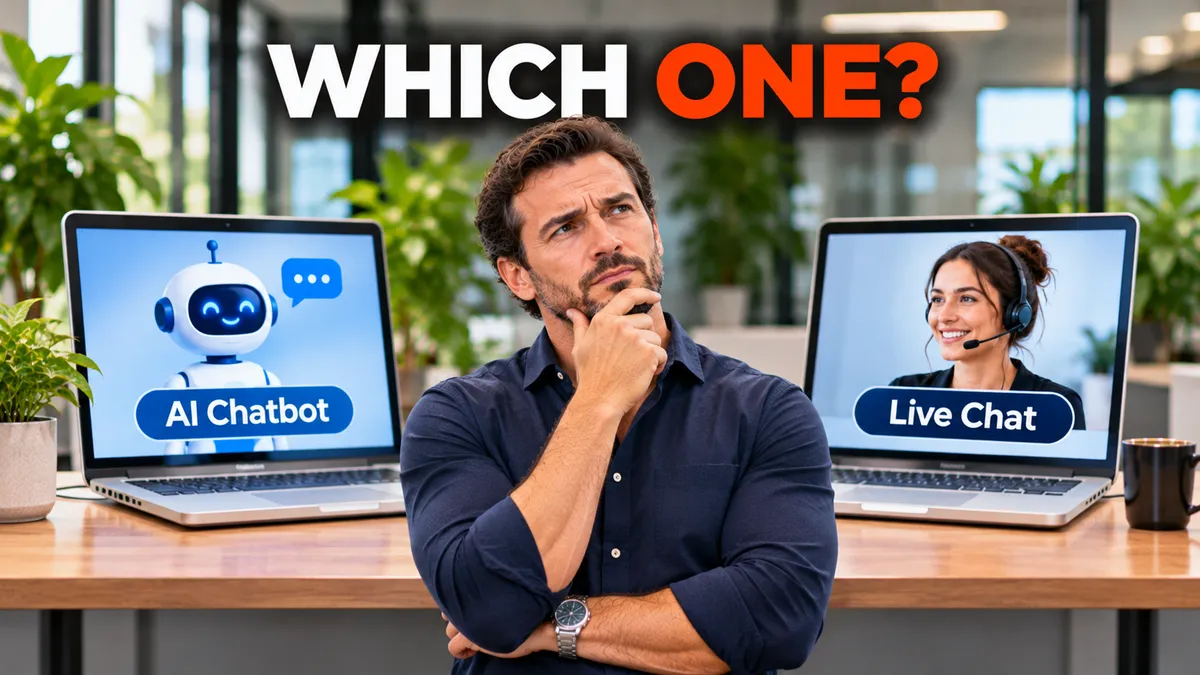
AI Chatbot vs Live Chat: Which Wins for Small Business?
Every small business owner with a website eventually faces the same question. Do you put a chat window on it, and if you do, who answers? One option is a live chat, where a real person types the replies. The other is an AI chatbot that answers from your own information, any hour of the day. I am Jarryd Holmes from Bolder Digital, and full disclosure, we build AI chatbots and place virtual assistants, so I have a stake in this. I have tried to give you the honest version. The answer for most small businesses is neither one alone, and Australian customers have strong views that make the “how” matter as much as the “which”.
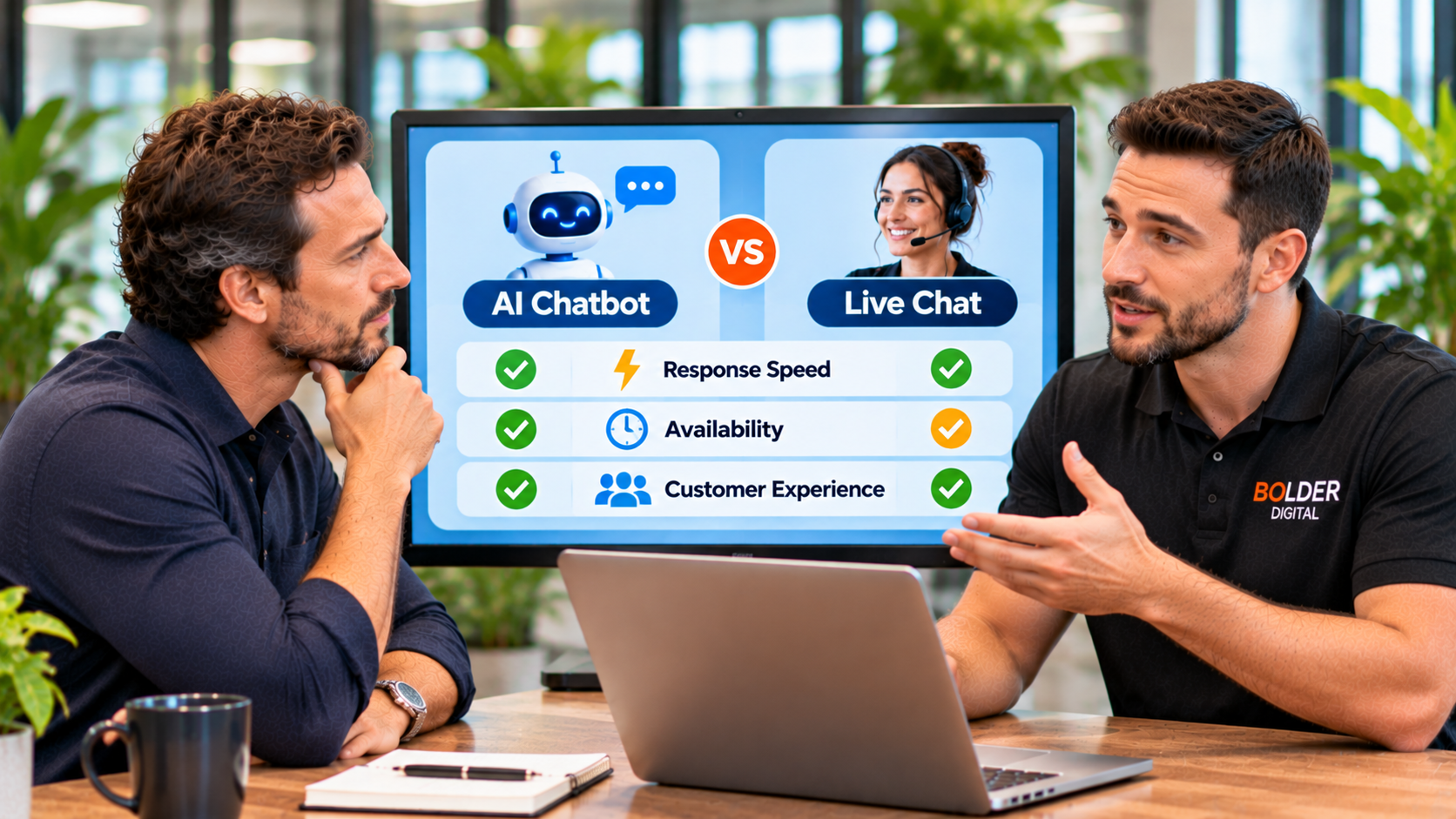
What We Mean by Each
Live chat:a real person, in a chat window on your website, replying to visitors as they message. It needs someone at a screen during the hours you advertise.
AI chatbot:software that answers visitors from the information you give it, such as services, prices, hours, and policies, captures their details, and books or passes things on. It replies in seconds, at any hour.
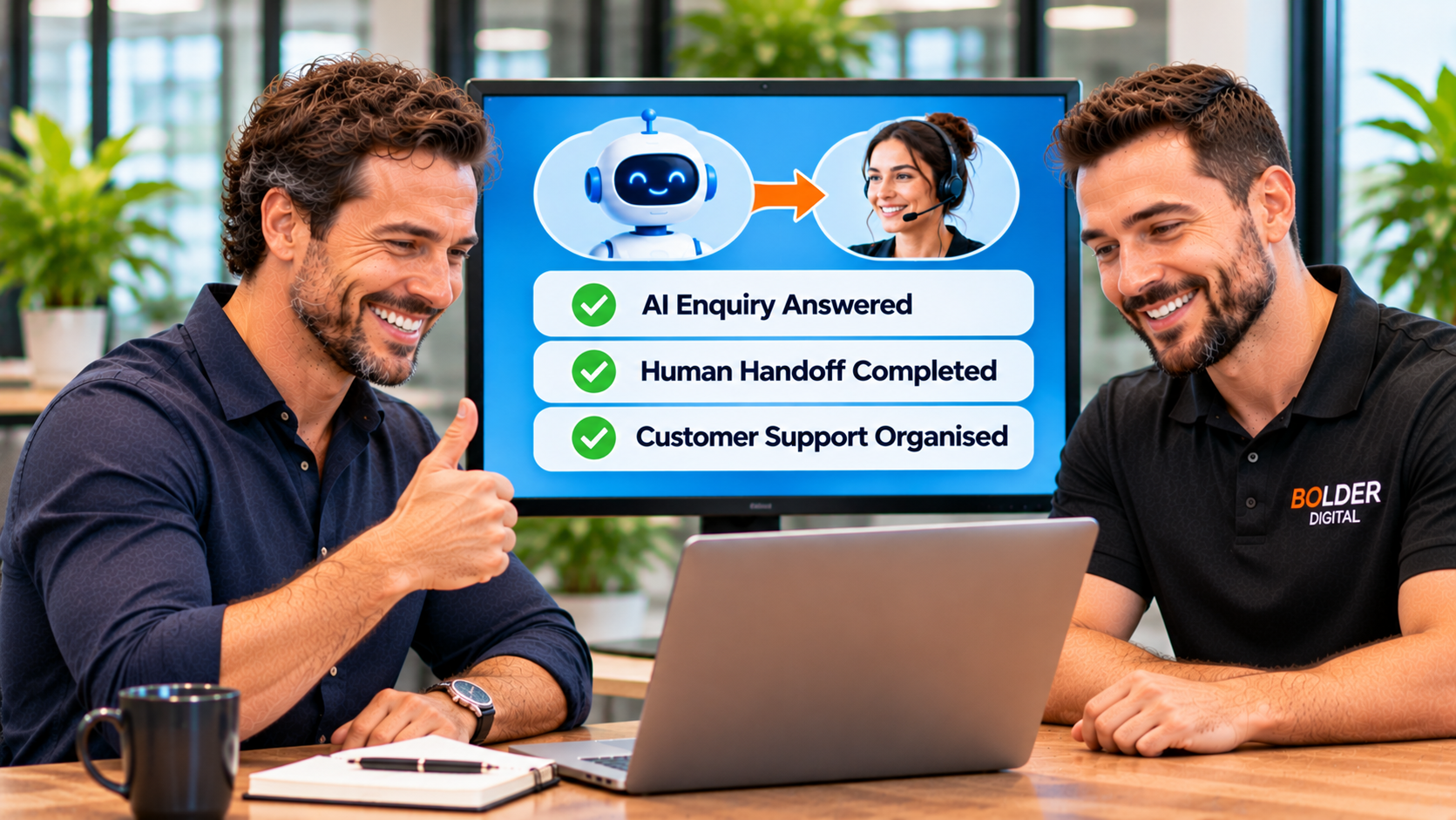
Hybrid:the chatbot answers first and handles the routine questions, with a person stepping in when it matters.
Where an AI Chatbot Wins
Speed.Vendor data suggests AI replies in a couple of seconds, while live chat averages well over a minute, and often several minutes at busy times. In chat, speed decides whether a visitor stays or leaves.
After hours.A human can only answer while at work. A chatbot answers at 9pm on a Sunday, when many people actually browse. One US vendor claims that more than a third of leads for home service businesses arrive after hours. Check that against your own enquiries, but the pattern is familiar to anyone in trades or hospitality.
Capacity.A person can typically handle only a few chats at once. A chatbot can handle many at the same time, which matters in a rush.
Cost.Vendor comparisons put a human handled routine chat at roughly US$5 to US$25, against well under US$2 for AI. Those are US figures and vary widely, but the gap is large. For a small business, the real difference is simpler. A chatbot costs a subscription. Live chat costs a person. Even a part time staff member costs more than A$2,000 a month once wages, super, and on costs are included, by my estimate, while a small business chatbot typically costs a few hundred dollars a month at most.
Consistency.A chatbot gives the same approved answer every time, and does not have a bad day.
Where Live Chat Wins
Judgement.Anything complex, unusual, or high stakes benefits from a human who can read the situation.
Emotion.An upset customer, a complaint, or a delicate subject needs empathy, not a script.
Big sales.If you sell high value work, a real conversation can build trust and close the deal.
Trust.Some people, particularly in Australia, simply want to talk to a person.
The Australian Factor
This part of the debate matters here more than it might elsewhere. Recent surveys suggest Australians are among the more cautious customers when it comes to AI service.
Twilio’s 2026 research reported that most Australians try to avoid AI agents and speak to a person, and that Australia showed some of the highest frustration among the markets surveyed when sent to a bot.
The same research found that almost half of Australians were comfortable talking to AI, and about a third would prefer it if it solved their problem faster.
Other surveys found that most Australians expect an AI tool to pass unresolved issues to a human, but far fewer say they get that in practice.
These are vendor commissioned surveys, so take the exact numbers with a pinch of salt. The message is consistent, though. People will use a chatbot if it is quick and useful, and they get angry when it traps them. The risk is not the chatbot itself. It is a chatbot with no way out.
The Problem With Live Chat Nobody Mentions
For a small business, live chat has a trap of its own. If nobody is actually watching, the window sits there, and visitors wait. A live chat that nobody answers is worse than no chat at all, because it promises a response and fails to deliver. Most small businesses cannot realistically staff a chat window all day, because the owner is busy doing the actual work.
So Which Wins?
For most small businesses, the answer is an AI chatbot first, with a human behind it. The chatbot gives instant, round the clock answers to routine questions and captures enquiries. A person takes over when the chat needs judgement, or when the customer asks for one.
Live chat on its own makes sense only if you have dedicated staff, a steady volume of conversations, and mostly high value or complex enquiries.
An AI chatbot on its own works well for businesses with routine, repetitive questions and a team that can follow up on captured leads.
A Quick Way to Decide
Ask yourself:
Do enquiries arrive outside business hours?If yes, a chatbot is almost essential.
Is anyone free to watch a chat window during the day?If not, live chat will fail.
How routine are the questions?Hours, prices, services, and bookings suit a chatbot. Complex advice suits a person.
How big is the average job?The higher the value, the more a human conversation helps.
How sensitive is the subject?Health, money, and complaints need extra care and clear handovers.
How to Run a Hybrid Well
A hybrid is only as good as the handover. A few rules make it work.
Tell people it is an AI.Say so in the first message. Pretending to be a person risks misleading customers and breaking their trust.
Make the human option obvious.Offer “talk to a person” at any time, not as a last resort.
Define the triggers.Hand over when the customer asks, when the chatbot is unsure, when someone is upset, and for complaints, refunds, and anything involving health, safety, or large sums.
Send a summary with the handover.The customer should never have to repeat themselves, and your team should see the whole conversation.
Be honest about hours.If a person is not available, say when one will be, and take their details.
Notify the right person quickly.A text or email to staff when a handover happens keeps the response fast.
Review conversations weekly.Read a sample, fix wrong answers, and add missing information.
Our guide on human handover covers the details, and our piece on chatbot mistakes lists what to avoid.
Who Covers the Human Side?
You do not need to be at your screen all day. Options include:
You or your team,during set hours, with notifications.
A virtual assistant,who can monitor handovers and follow up on leads during business hours. This is a service we offer, and it can be much cheaper than a full time employee.
A callback promise,where the chatbot captures details and a person calls within a stated time.
Common Mistakes
Showing “online now” when nobody is watching.
A chatbot with no human path.
Letting the chatbot guess instead of using approved information.
Setting it up once and never reviewing it.
Using a chatbot for sensitive matters without a clear handover.
What to Measure
first response time
enquiries captured outside business hours
how many chats the chatbot resolves, and how many it hands over
bookings or leads from chat
customer feedback after chats
If a lot of customers ask for a human straight away, or leave angry, adjust your handover and your greeting.
How Bolder Digital Approaches This
At Bolder Digital, we build AI chatbots that answer from your approved information, capture leads, book appointments, and hand over to a person cleanly, with the right triggers for your business. We can also arrange a virtual assistant to cover the human side. You can see more on our AI Chatbot service and our virtual assistants in Tasmania.
The Bottom Line
AI chatbot or live chat is the wrong way to frame it. The AI chatbot wins on speed, hours, capacity, and cost. Live chat wins on judgement, empathy, and the big conversations. Australian customers want the first and demand the second. Put the chatbot first, make a real person easy to reach, be honest about which is which, and your small business gets the best of both.
Frequently Asked Questions
Is an AI chatbot cheaper than live chat?
Usually, by a wide margin. Vendor figures put human handled chats at several dollars to tens of dollars each in US terms, against a small fraction of that for AI. For a small business, the main difference is a monthly subscription versus paying a person for their time.
Do Australian customers accept AI chatbots?
Many do, if the chatbot is quick and helpful, but surveys suggest Australians are cautious and dislike being trapped by a bot. A clear AI disclosure and an easy route to a human matter.
Should a small business use live chat?
Only if someone is available to answer promptly during the hours you show. If not, an unattended live chat is worse than none, and an AI chatbot with handover is the safer choice.
What is a hybrid chatbot?
An AI chatbot that handles routine questions and captures details, with defined triggers that pass the conversation to a person, along with a summary.
Can a virtual assistant cover chat handovers?
Yes. A virtual assistant can watch for handovers, reply to leads, and follow up during business hours, usually at much lower cost than a full time employee.
Jarryd Holmes, Founder & Owner, Bolder Digital | Prospect Vale, Tasmania |bolderdigital.com.au