
Social Proof in Digital Marketing: Beyond Just Star Ratings
A star rating is the first thing a potential customer sees, and it is rarely the last. A 4.8 gets you onto the shortlist. It does not tell a worried homeowner whether you will turn up on time, tell a parent whether you are kind to nervous kids, or show a business owner that you have solved a problem like theirs. At Bolder Digital, we treat stars as the entry ticket. The deciding work is done by the rest of the proof.
What Stars Actually Do
Consumer surveys show how central reviews have become. BrightLocal’s 2026 survey of about 1,000 US consumers found that 97 percent read reviews when looking at local businesses, 68 percent will only use a business with four stars or more, and the minimum people accept has been rising. Research from Northwestern’s Spiegel Research Center, on products, found that most of the benefit comes from the first handful of reviews, and that purchase likelihood tended to peak below a perfect 5.0, because flawless scores can look too good to be true.
Two sensible conclusions follow. Reviews matter a lot, and you do not need to be perfect. You need to look real, recent, and believable.
Why Stars Alone Fall Short
A star rating is anonymous and general. It cannot answer the questions people are really asking:
Is this business real?
Have they done what I need before?
Will they be reliable and honest?
Is it worth the price?
Are they used to people like me?
Each of those needs a different kind of proof, and that is where the rest of the toolkit comes in.
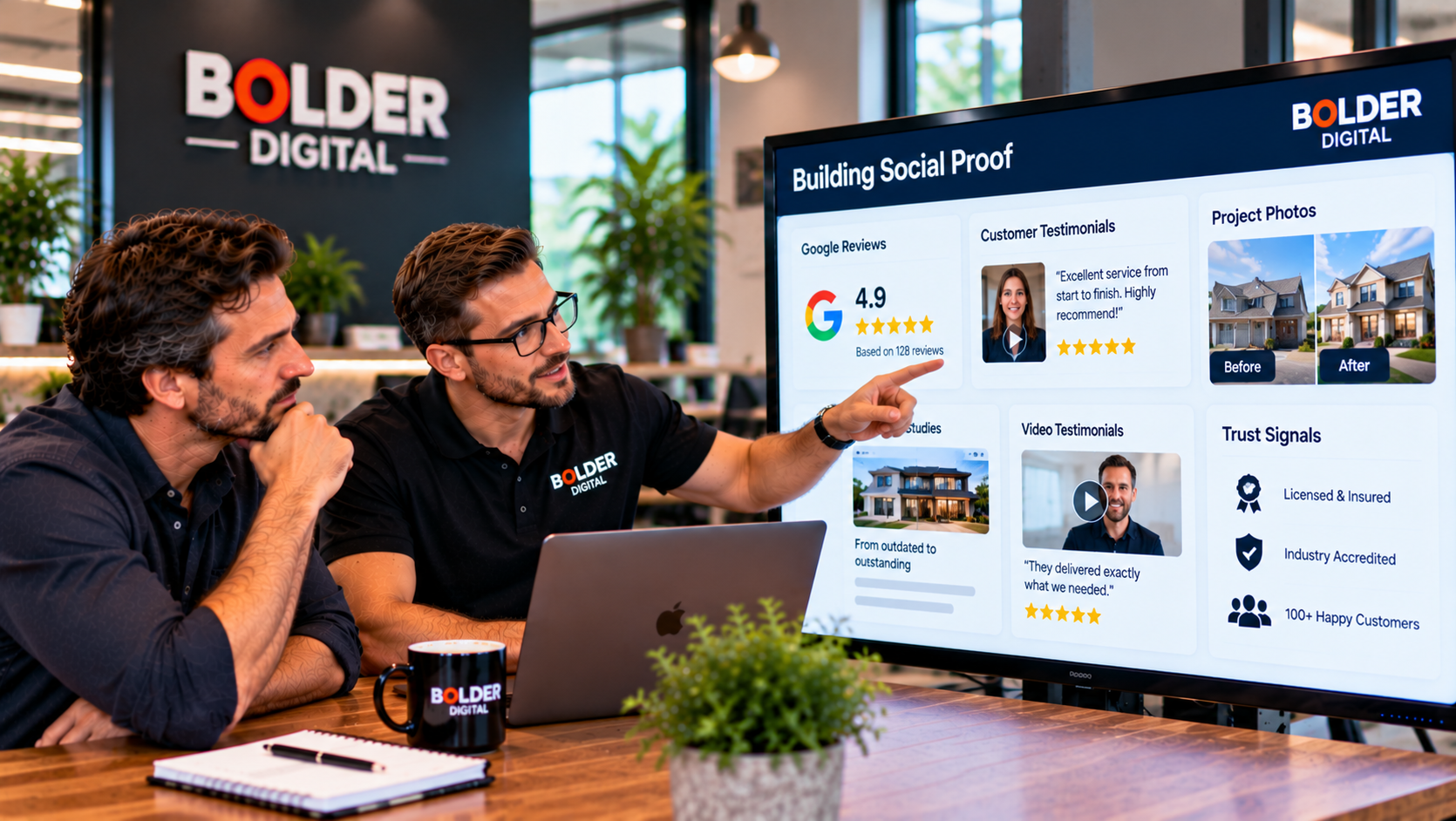
The Proof Toolkit
Specific reviews. Reviews that mention the service, the outcome, and what it was like to deal with you carry far more weight than “great service”. You cannot script them, but you can prompt them. A short note such as “if you can, tell us what we helped with and how it went” produces better reviews than a bare request. Reply to each one in a way that shows you read it.
Named testimonials. A short quote with a first name, a suburb or business, and a photo, used with permission, is more convincing than an anonymous line. Place them near the page’s call to action, where people are deciding.
Case studies. A simple story of the problem, what you did, and the result is the strongest proof for bigger purchases. For a tradie, that might be a job summary with before and after photos and the suburb. For a professional firm, it might be an anonymised matter. Always get consent, never reveal anything confidential, and keep the numbers honest.
Video. A thirty to sixty second phone video of a happy customer is persuasive and cheap. Add captions, since many people watch with the sound off.
Customer photos and posts. Photos customers share, tags on social media, and photos in Google reviews all show real people using your business. Ask before you reuse anything.
Numbers. “Serving Launceston since 2012”, “over 1,000 jobs completed”, or “4.9 from 78 Google reviews” are quick signals of experience. They must be true, specific, and kept up to date.
Credentials and memberships. Licences, accreditations, industry memberships, and awards all help, especially if people can verify them. If you were a finalist, say finalist, not winner.
Local standing. Sponsoring a local club, appearing in local media, and partnerships with known local organisations all signal that you are part of the community.
Real time signals. Messages such as “booked three times today” can add urgency, but only if they are true. Invented urgency destroys trust.
Match the Proof to the Doubt
Instead of a wall of testimonials on one page, put each type of proof where the matching worry arises.
Homepage: a ratings summary with review count, a few credentials, and a short quote or two.
Service pages: case studies and reviews about that specific service.
Pricing pages: reviews that mention value and honesty about cost.
Contact pages: reviews that mention responsiveness, and your real address and photos.
Local pages: reviews and examples from that area. This is a major part of our suburb based work, where each page needs its own local evidence.
Link your reviews back to the real source, such as your Google profile, so visitors can check them. Live reviews are more convincing than a block of text you typed yourself.
Recency Counts
Customers want to see that you are still doing good work. Surveys consistently show that recent reviews matter more than old ones. A steady flow beats a burst. A few reviews each month will do more than fifty collected last year and nothing since.
Do Not Hide the Imperfect Ones
A handful of lower ratings makes the rest look genuine. What matters is how you respond. Reply calmly, say what you will do, and offer to fix it offline. In BrightLocal’s data, most consumers said they would use a business that replies to all its reviews, compared with under half for one that replies to none. How you handle a complaint is itself a form of proof.
The Rules You Must Follow
Social proof only works if it is honest, and it is regulated.
Genuine and typical. Reviews and testimonials must be real, and not misleading about what customers usually experience. Fake or incentivised reviews are generally treated as misleading conduct under the Australian Consumer Law.
Google’s policies. Google restricts offering incentives for reviews, and it prohibits review gating, which means asking only happy customers while steering unhappy ones elsewhere. Ask everyone.
Permission. Get written consent before using a customer’s name, photo, or story.
Confidentiality. Be careful that a case study does not identify the client.
Profession specific rules. Some professions have strict rules about testimonials. Registered health practitioners face tight restrictions, and lawyers and financial advisers have their own standards. We cover this in our piece on marketing for professional services.
Keep evidence. If you publish a claim or a number, be ready to back it up.
Collect Proof on Purpose
Good proof rarely arrives by accident. Build it into how you work:
Ask at the moment of success, when the customer is happiest.
Make it easy with a direct link, a QR code, or a text message.
Train staff to ask everyone, not just the obvious fans.
During follow up calls, ask whether you can quote what they said.
Keep a simple proof library in a spreadsheet, with the quote, the permission, and the date.
Set a monthly target for new reviews and testimonials.
Measure What Works
You do not need elaborate tests. Notice whether enquiries rise after you add case studies to a service page. Ask new customers what convinced them. Track your rating trend, how many reviews you gain each month, and your reply rate. Over time you will see which kinds of proof do the most for your business.
How Bolder Digital Approaches Social Proof
At Bolder Digital, we start by finding the doubts your customers have, then build the proof to answer them. We set up an ethical review process, create testimonial and case study formats that respect permission and confidentiality, and place proof where it matters across your site and suburb pages. You can see how this fits into our review management and Google Business Profile optimisation services.
The Bottom Line
Stars get you noticed. Specific reviews, named testimonials, case studies, credentials, and local standing get you chosen. Match each kind of proof to the doubt it answers, keep it recent and genuine, follow the rules, and collect it on purpose. A business that looks real, capable, and well regarded does not need to shout.

Frequently Asked Questions
Is a perfect five star rating the best?
Not necessarily. Research on products suggests purchase likelihood tends to peak below 5.0, and a flawless score can look too good to be true. Findings vary, but a high rating with plenty of genuine reviews and honest replies is more believable.
What kinds of social proof work besides reviews?
Named testimonials, case studies, short customer videos, customer photos, specific numbers, credentials and memberships, local media and community involvement, and honest crowd signals.
Can I offer a discount for a review?
Not safely. Google restricts offering incentives for reviews, and fake or incentivised reviews are generally treated as misleading conduct under Australian consumer law. Ask every customer, and make it easy.
Should I delete negative reviews?
Not genuine ones. Reply calmly, explain what you will do, and take the detail offline. How you respond is itself reassuring. You can ask Google to remove reviews that break its policies.
Where should I place testimonials and case studies on my website?
Near the decision points, matched to the worry. Case studies on relevant service pages, reviews about value near pricing, responsiveness reviews near the contact form, and local evidence on local pages.
Jarryd Holmes, Founder & Owner, Bolder Digital | Prospect Vale, Tasmania | bolderdigital.com.au