

Voice AI Setup: What Actually Happens in the First Week
Search for how long a voice AI setup takes and the answers range from "live in under an hour" to "six to twelve weeks". Both can be true, because they describe very different projects. At Bolder Digital, when a business asks what the first week looks like, we describe a focused start: one clear use case, such as answering calls and booking appointments, built properly and brought live in stages.
Here is what that week looks like, day by day, and what we need from you along the way.
Day One: Mapping the Calls You Actually Get
Everything good about a voice agent comes from knowing what callers actually want. We start by listing the types of call your business receives, using your real call history, missed call log, and voicemail if you have them. We then note:
your opening hours and what changes on public holidays
your services, prices, and booking rules
the twenty or so questions callers ask most often
who should receive urgent or sensitive calls, and how
anything the agent must never say or promise
We also settle the compliance basics at this stage, including the recording announcement and the line that tells callers they are speaking with an AI assistant. I cover the reasoning in our voice AI compliance guide.
Day Two: Building the Agent
With the call map in hand, we build. That means loading your information into the agent, setting its voice and tone, and connecting it to your calendar or CRM so it can check real availability and write bookings directly.
We also write the handoff rules: which situations go straight to a person, what the agent says while transferring, and what summary reaches you. For an Australian business, we check how the voice handles local place names and phrasing, since accents and local terms are a known weak spot for voice systems.
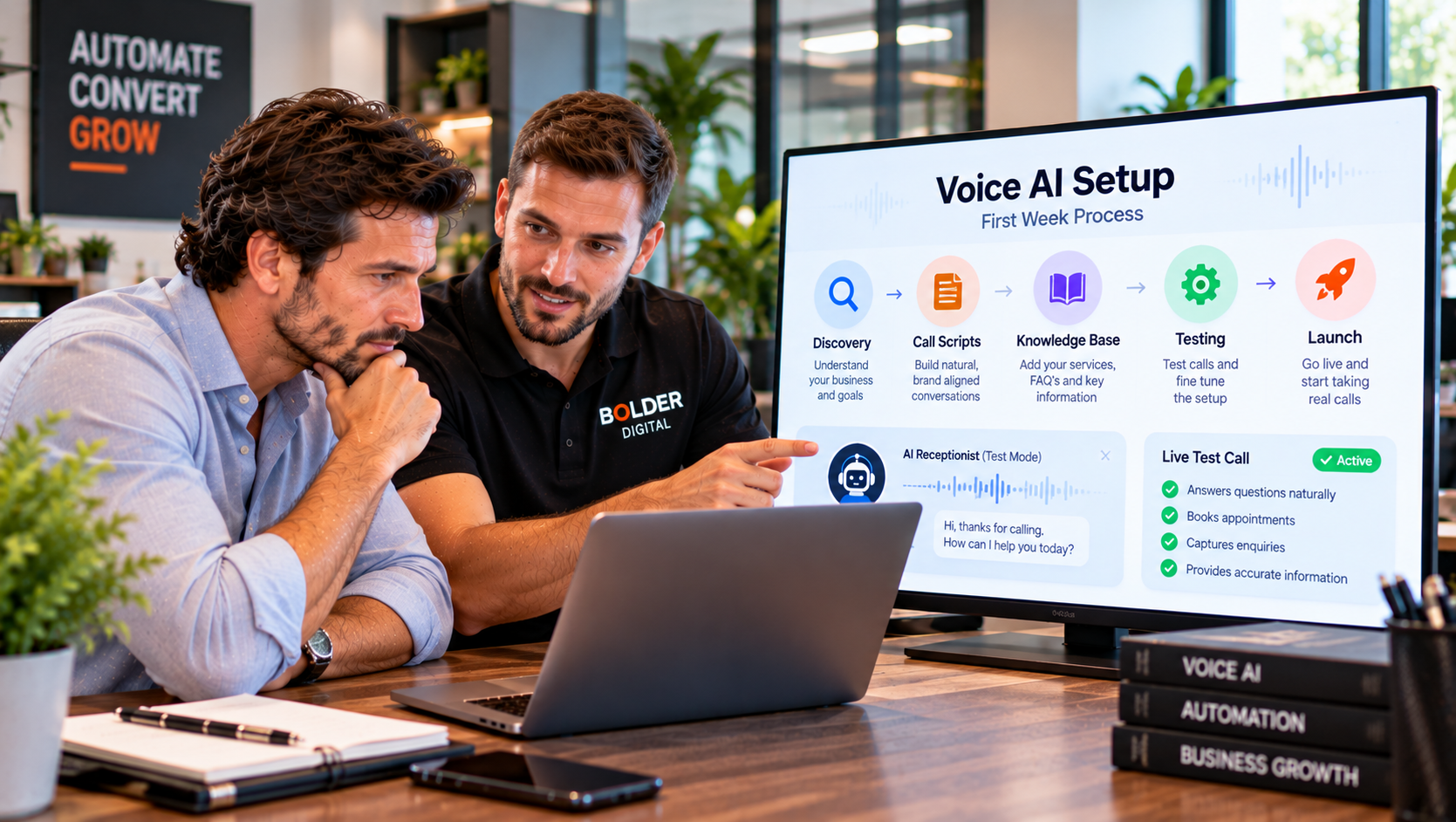
Day Three: Testing Before Anyone Real Calls
Before any customer hears the agent, we call it ourselves, and so do you or your team. We ask it the twenty most common questions and check every answer against your real information. We then try the awkward calls: a caller who is upset, one who changes their mind halfway through a booking, one who asks something it should not answer, and one who asks for a person.
Everything that sounds wrong gets fixed now, not after launch.
Day Four: Connecting Your Phone Line
This is the step owners worry about most, and it is usually simpler than expected. You do not normally need to move your number. Instead, your existing line forwards calls to the agent, and your number stays with your current provider.
There are a few ways to set that up:
Overflow:your phone rings first, and calls go to the agent only if you are busy or do not answer.
After hours:calls go to the agent outside your opening hours.
Everything:the agent answers every call from the start.
Most businesses begin with overflow and after hours. Setting up forwarding is typically a short job done through an online account or a short code, and it is easy to switch off if needed. We test with calls from outside numbers, and check that your carrier's voicemail does not pick up before the agent does.
Moving the number itself, called porting, is a separate decision. Australian timeframes vary widely by number type, from hours for mobiles to a couple of weeks or more for landlines, so confirm with your provider if you want to go that way later. Many businesses never need to.
Day Five: A Soft Launch
Now real customers reach the agent, but in a controlled way. Rather than switching everything on, we start with a slice, usually after hours and overflow calls. That limits the risk while giving us genuine calls to learn from, and it lets your team keep handling the rest as usual.
We watch the first live calls closely. A problem that shows up on day five is a same day fix. The same problem found in week three is a complaint from a customer.
Day Six: Reviewing Real Calls
We read the transcripts and listen to the recordings. We are looking for:
questions the agent could not answer
moments where a caller got confused or frustrated
bookings that landed in the wrong slot or did not land at all
handoffs that did not reach the right person, or arrived without a useful summary
We fix the three biggest gaps, usually by adding missing information or tightening a handoff rule, and we update the agent.
Day Seven: The First Check In
At the end of the week, we sit down with you and look at the numbers: calls answered, bookings made, calls handed to a person, and anything missed. Then we decide together whether to widen the agent's coverage, for example by adding business hours overflow, or to hold for another few days.
This is not the finish line. A voice agent improves as real calls reveal what callers ask, so expect it to keep getting better over the following weeks.
What We Need From You
The week goes smoothly when a few things are ready:
your services, prices, and booking rules in writing
your opening hours and holiday changes
access to your calendar or booking system
the name and number of the person who should receive urgent calls
a few hours of your time, mostly on day one, plus the day seven review
What Can Go Wrong, and How We Avoid It
The common problems are small and fixable:
Forwarding loops or gaps,which we catch with test calls.
Voicemail answering first,which we check by adjusting ring and timing settings.
Out of date information,which we avoid by loading approved, current content.
Double bookings,which we catch by testing calendar writes before launch.
How Bolder Digital Runs It
At Bolder Digital, we treat the first week as the start of the relationship, not a handover. We map the calls, build the agent, test it hard, connect your line, launch in stages, and watch the real calls closely. You can see how this fits into ourAI Receptionist service.
The Bottom Line
A good voice AI setup is not a switch you flip. It is a short, structured week of mapping, building, testing, connecting, soft launching, and reviewing, with a business that stays in control throughout. Start with one use case, go live in stages, and let real calls guide the tuning.

Frequently Asked Questions
How long does it take to set up a voice AI agent?
It depends on scope. A focused first use case, such as answering calls and booking appointments, can be live within about a week when information is ready and integrations are simple. More complex builds with several systems take longer.
Do I need to change my phone number?
Usually not. Most businesses forward calls from their existing number to the agent, so the number stays with the current provider. Porting is a separate step that can take days to weeks depending on the number type, and many businesses never need it.
Can the agent answer only after hours at first?
Yes, and it is a common way to start. Overflow and after hours routing limits risk while you see how it performs, and you can widen coverage once you are comfortable.
What if the agent gets something wrong in the first week?
It is expected and fixable. That is why we start with a limited slice of calls and review real transcripts daily, so problems are caught and corrected quickly.
How much of my time does setup take?
A few hours across the week, mostly at the start to share information and at the end to review results. Staff may also help with test calls.
Jarryd Holmes, Founder & Owner, Bolder Digital | Prospect Vale, Tasmania |bolderdigital.com.au