Voice AI vs Answering Service: An Honest, Detailed Comparison
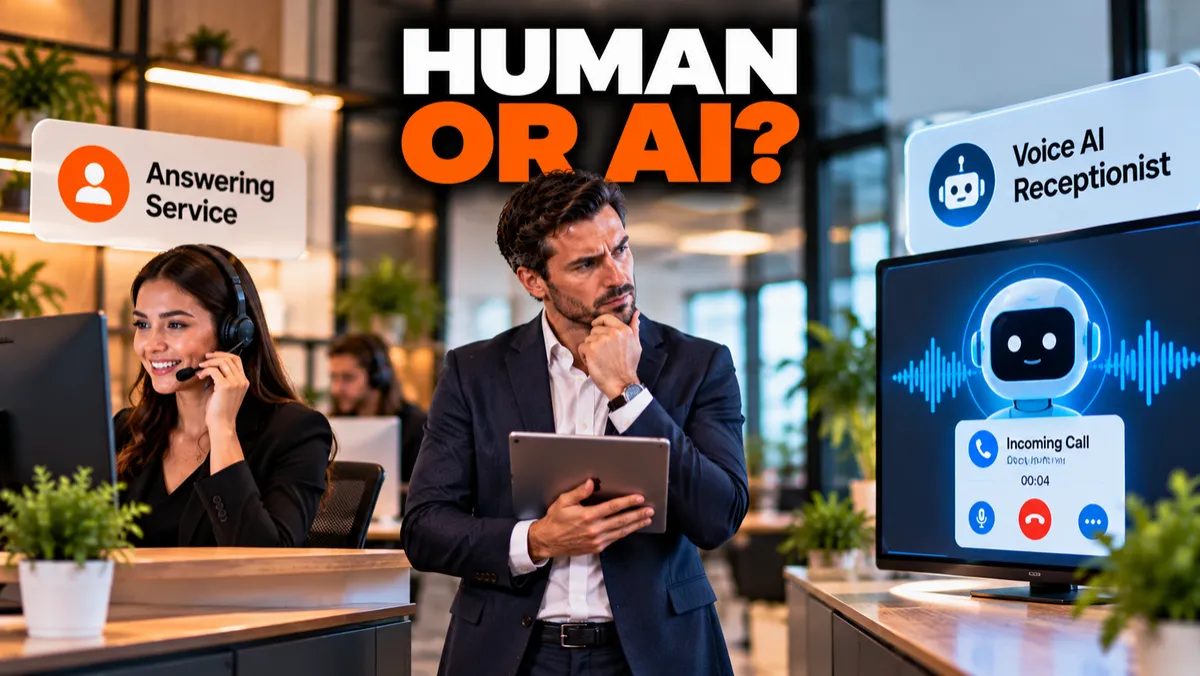
If you want to stop missing calls, you have probably heard three names: answering service, virtual receptionist, and AI receptionist. They are sold as if they were interchangeable, and they are not. At Bolder Digital, we build voice AI, so weigh what follows with that in mind. We would still rather you pick the right tool than the one we sell, so this comparison tries to be fair, including about where a human service genuinely wins.
What an Answering Service Actually Does
A traditional answering service is a team of people, in Australia or overseas, who answer calls in your business name. They follow a script you give them, take the caller's details and reason for calling, and pass it on. Some can transfer a call to you, and some do more, such as booking appointments or dispatching an on call technician.
The key point is what happens after the call. In most cases, the caller ends up as a message, and you still have to call back.
What Voice AI Does Differently
A voice AI agent answers the call itself, in your business name, and tries to finish the job during the call. It answers questions from your approved information, books into your calendar, captures details into your CRM, and hands the call to a person when it should. In other words, it aims to turn a call into a completed task, not a message.
One independent summary put it neatly. The main difference is not human versus AI. It is message taking versus workflow completion.
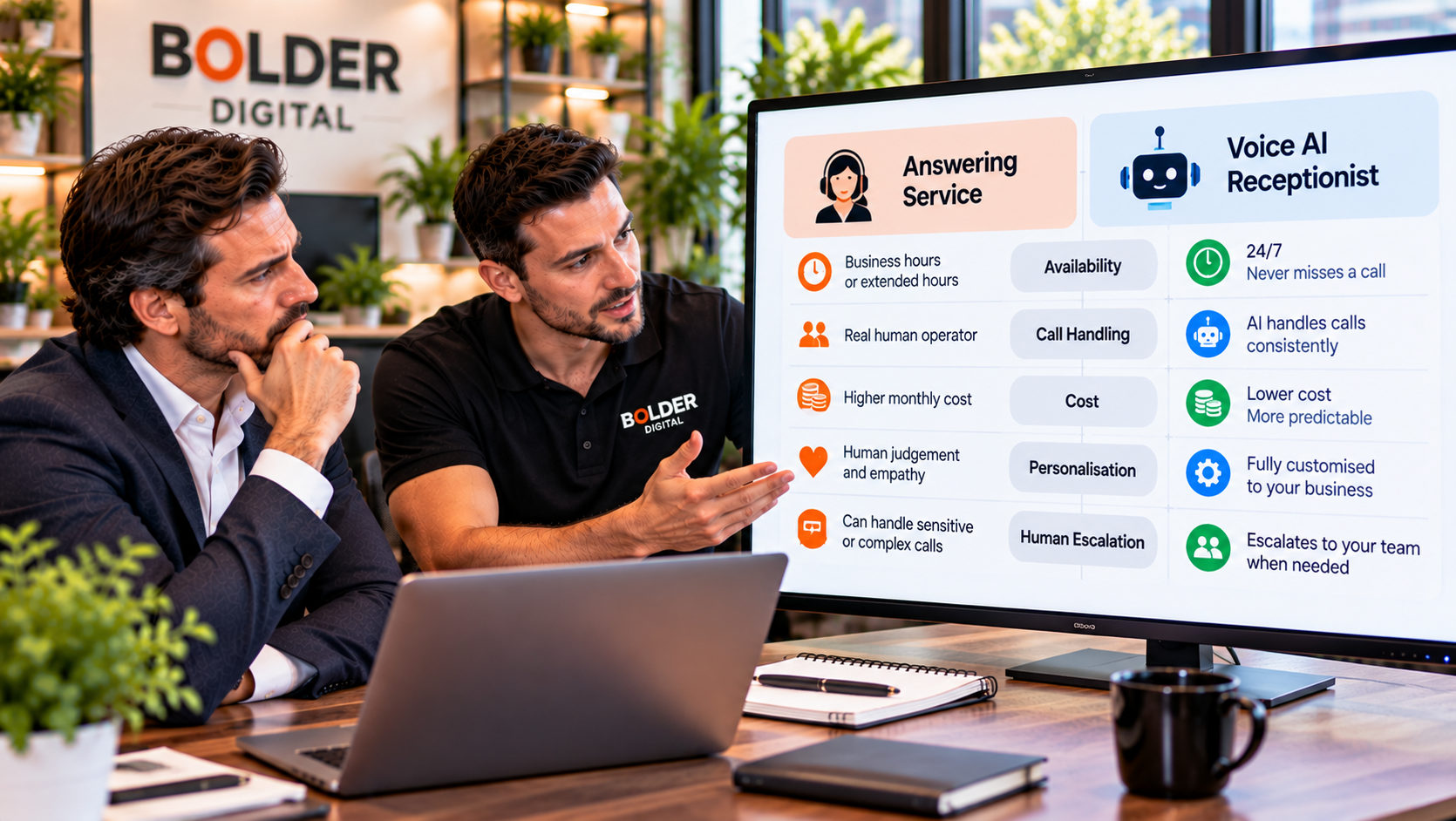
Side by Side
Answering service | Voice AI | |
|---|---|---|
Who answers | A person, usually working from a script | Software |
Typical outcome | A message or a transfer | A booking, answer, or captured lead |
Several calls at once | Limited by staff on shift | Yes |
Pricing | Plan fee plus per call or per minute | Often a flat monthly fee, sometimes with minute allowances |
Knowledge of your business | What is on the script | As deep as it is trained |
Empathy and judgement | Human, within the script | Limited, so it should hand over |
Consistency | Varies by operator | Same flow every call |
Setup | Usually quick | Needs proper build and testing |
What It Costs in Australia
Published Australian figures vary, so treat these as rough ranges from 2026 provider guides, which are partly written by vendors.
Message taking: from roughly $25 a month plus a couple of dollars a call.
Live answering with transfers: commonly a few dollars per call, or per minute plans in a similar range, with after hours loading of around one and a half to two times in some cases.
AI receptionists: commonly a flat monthly fee from around $99 into the low hundreds, often with a minute allowance and an overage rate.
An illustration, using made up volume. At 150 calls a month, a per call service at about three dollars a call comes to around $450. A flat AI plan might sit in the $150 to $300 range, though watch overage. A busy month raises the per call bill but not the flat one, and a quiet month costs the flat plan the same as a busy one. The right choice depends on your volume, your call length, and any after hours loading.
Whichever you consider, ask what is included and what happens when you go over.
Where a Human Service Genuinely Wins
This is the part vendors tend to play down. A human answering service is the better choice when:
Calls are emotional. A distressed caller, a complaint, or news of a death or illness needs a person who can respond with real empathy. Funeral services, counselling, and similar settings are obvious examples.
Judgement is needed. Complex or regulated intake, such as legal or medical matters, often needs a person to read the situation.
A person must be on the line. Some businesses, because of professional rules or their own policy, need a human voice at all hours.
Dispatch is the job. For on call technicians, an operator who can ring through the roster may be exactly what you need.
Volume is tiny. If you get very few calls, a managed service of either kind may be more than you need.
Where Voice AI Wins
Routine calls. Bookings, opening hours, pricing questions, and call back requests are well suited to automation.
Capacity. It can handle several calls at once without a queue.
Cost predictability. A flat fee avoids paying more for a good month, though minute overages need watching.
After hours. It is the same service at 9pm as at 9am.
Consistency. It follows the same approved information every time.
Completing the task. It books the appointment instead of leaving you with a message.
Risks on Each Side
Neither is risk free. A human service can mis-take a name, work from outdated instructions, or vary from one operator to the next. Voice AI can mishear, misstate something if it is poorly trained or its information is out of date, and sound off to some callers, particularly with Australian accents and place names, as I covered in our accents piece. Both need testing, clear escalation rules, and a way for a person to take over.
Data, Location, and Compliance
Ask where calls are answered or processed, where recordings and transcripts are stored, and who can access them. For a human service, ask whether operators are in Australia or offshore. For voice AI, ask where the data is hosted and whether conversations are used to train anyone's models. In either case, recording should be announced at the start of the call, and an AI should say it is an AI. I cover this in our voice AI compliance guide.
Questions to Ask Any Provider
Can I hear real sample calls for a business like mine?
What happens when a caller wants a person, and how fast does it happen?
What is the full monthly cost for my call volume, including loading and overage?
What is the contract length, and how do I cancel?
Where are calls handled and data stored?
How are mistakes found and fixed?
The Honest Answer Is Often Both
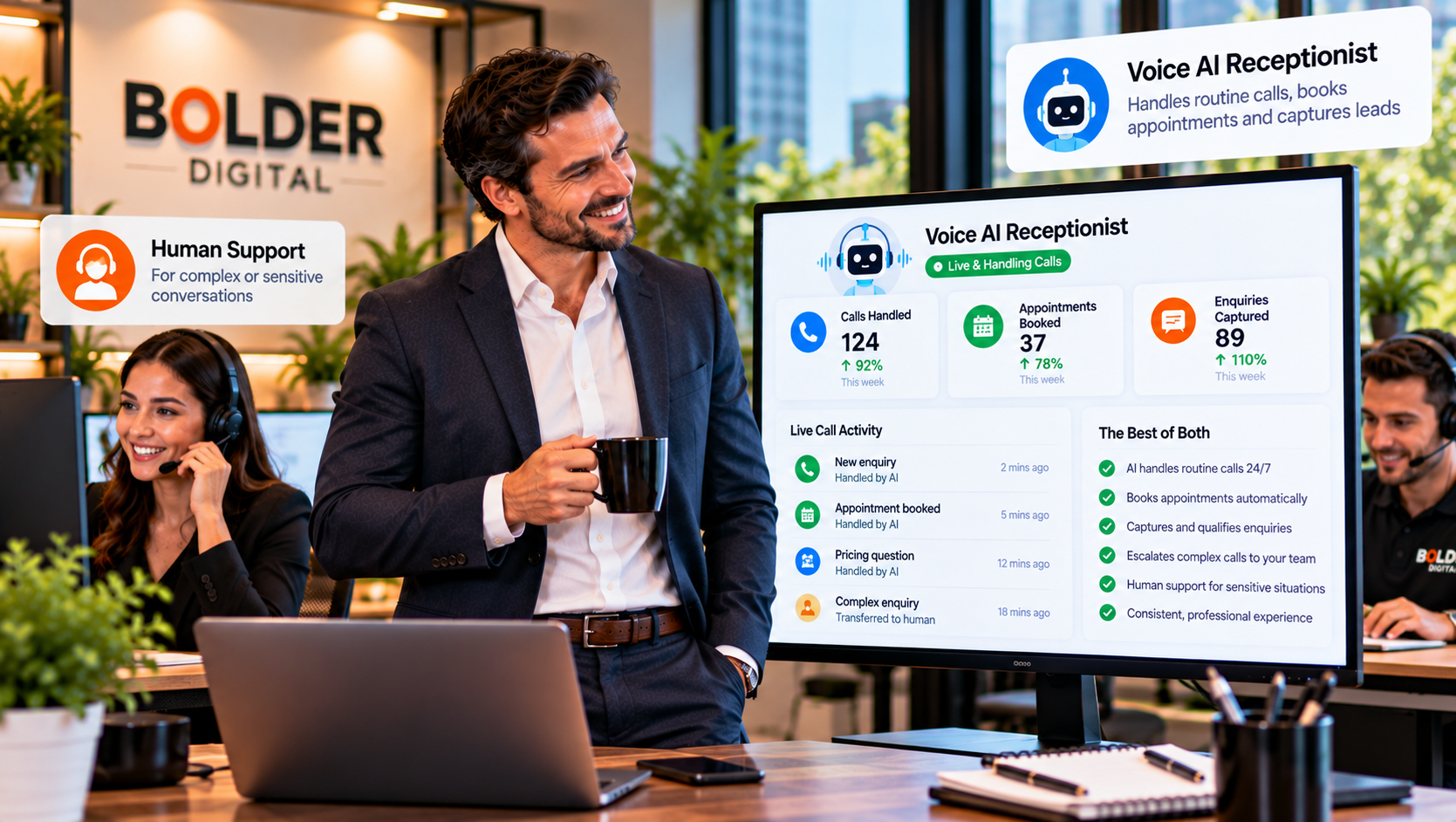
For many businesses, the sensible setup is a hybrid. Voice AI handles routine calls and after hours enquiries, books appointments, and captures leads. Anything urgent, emotional, or complex goes straight to a person on your team, or to a human service you keep for those moments. That way the human time you pay for goes where it matters.
A low risk way to find out is to start with overflow and after hours calls only, compare it with your current setup for a month, and look at completed bookings and missed calls before deciding.
How Bolder Digital Approaches This
At Bolder Digital, we start by looking at your actual calls. If most are routine, we recommend voice AI with a clear human handoff. If a large share are emotional or high stakes, we say so and suggest keeping a person at the front. You can see how this fits into our AI Receptionist service.
The Bottom Line
An answering service takes the call off your hands and leaves you a message. Voice AI aims to finish the job. For routine, high volume, after hours work, voice AI usually wins on cost, capacity, and completed outcomes. For emotional, complex, or regulated calls, a person still wins. Look at your own calls, choose on what needs to happen after the phone rings, and do not be afraid to use both.
Frequently Asked Questions
What is the main difference between voice AI and an answering service?
An answering service usually takes a message or transfers the call, leaving you to act on it. Voice AI aims to complete the task during the call, such as answering a question or booking an appointment, and hands over when it should.
Is voice AI cheaper than an answering service?
Often, for routine call volumes, because many AI plans are a flat monthly fee while human services usually charge per call or per minute. The result depends on your call volume, call length, loading, and overage, so compare real quotes.
When is a human answering service better?
When calls are emotional or sensitive, need real judgement, must have a person on the line, or involve dispatching an on call technician. A human is also a sensible choice if call volume is very small.
Can I use both voice AI and a human service?
Yes, and it is a common approach. Voice AI handles routine and after hours calls, and anything urgent or sensitive is handed to a person or a human service.
What should I ask before choosing a provider?
Ask to hear sample calls, how a handoff to a person works, the full cost at your volume including overage, the contract terms, where calls are handled and data is stored, and how mistakes are fixed.
Jarryd Holmes, Founder & Owner, Bolder Digital | Prospect Vale, Tasmania | bolderdigital.com.au